
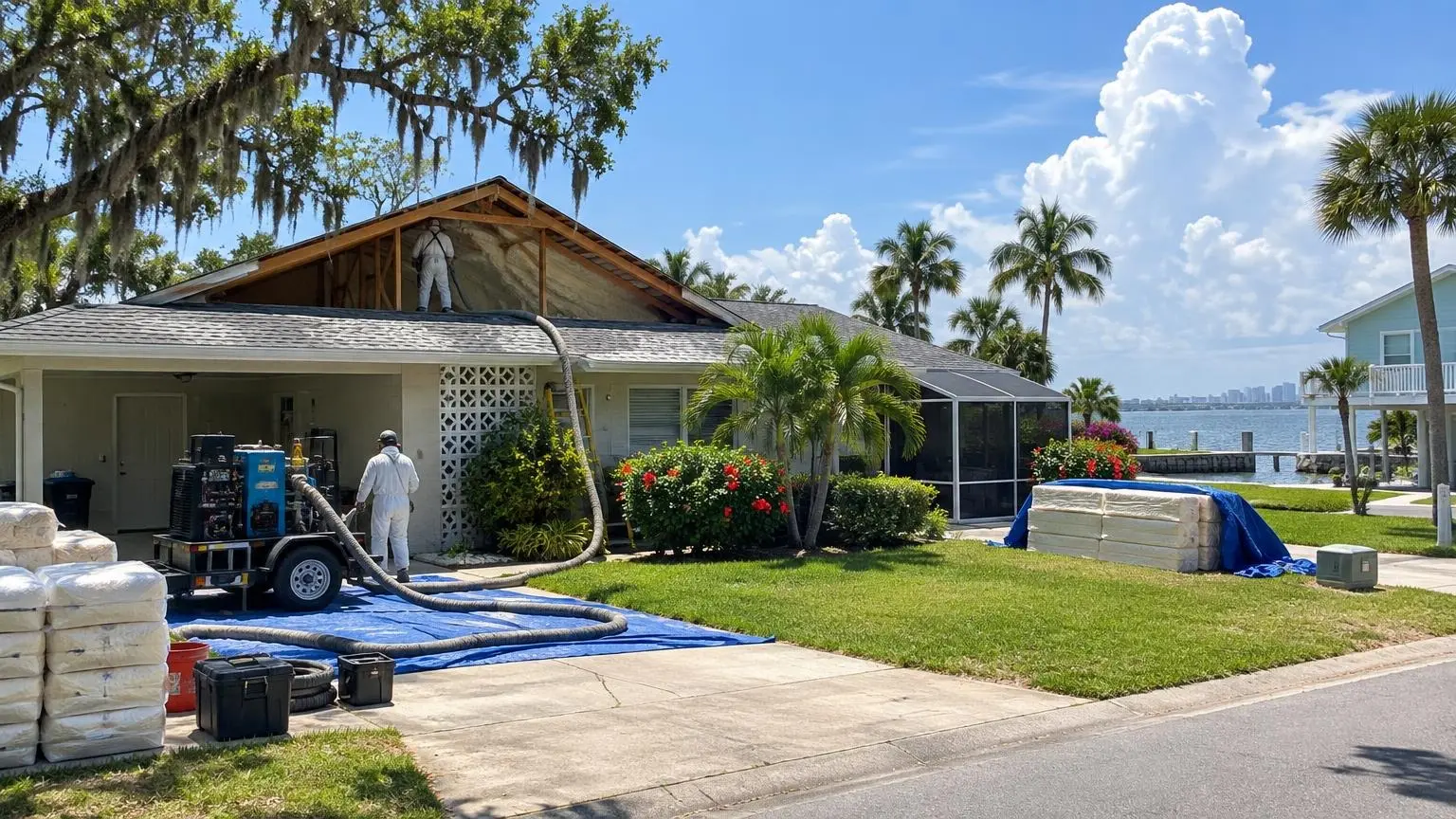
Open-cell and closed-cell foam
Spray Foam Insulation in Clearwater, FL
The right foam for each surface: open-cell where air sealing and value matter, closed-cell where moisture or tight space calls for it.
- Free on-site estimates
- Written quote naming foam type, thickness and R-value for each area
- Attic, ducts and roof leaks checked before anything is covered
Choosing Between Two Foams
Spray foam insulation is sprayed as a liquid, expands to fill gaps and cracks, and cures in place, so a single layer both insulates and stops air. In a Clearwater house that air seal matters as much as the R-value: the Tampa airport's 1991-2020 climate record shows a year-round average relative humidity of 74.1%, and every leak in the ceiling or walls lets that damp air in for the air conditioner to deal with. We spray two kinds of foam, and the first decision on each job is which one goes where.
Open cell vs closed cell
Open-cell foam cures soft and spongy. HomeGuide rates it at about R-3.5 to R-3.7 per inch, and it expands many times its sprayed volume, so it fills irregular rafter bays and around wiring easily. It blocks air very well and dampens sound, but water vapor can pass through it, and it will soak up liquid water. It is the less expensive of the two per square foot.
Closed-cell foam cures hard and dense at roughly R-5 to R-7 per inch. At normal thickness it slows vapor to a crawl, takes on very little water and adds some stiffness to what it is sprayed on. It costs more per inch but gives more R-value in a shallow space.
Where each one fits in a Pinellas home
On the underside of a pitched roof deck over a typical attic, open-cell is common: there is room for the depth, and its lower cost per square foot adds up over a full roof. Closed-cell is the usual pick where water or space is the issue: low-slope roofs with shallow rafters, the inside of concrete block walls, garage ceilings under a bonus room, cantilevered floors and small cavities where a few inches has to reach a target. On some jobs we use both, for example closed-cell at the roof edges and open-cell across the field of the roof.
Code targets we size to
The 2023 Florida Building Code, Energy Conservation lists R-38 for ceilings and R-13 for wood-frame walls in climate zone 2, which covers Pinellas, Pasco and Hillsborough counties, and R-6 on the interior of mass (block) walls. Foam is not always installed to those numbers in retrofits, because the energy code applies differently to existing homes, but we use them as the reference, and the quote states the thickness and R-value for each area so you can see where it lands.
The unvented attic question
When foam goes under the roof deck, the attic becomes part of the conditioned house instead of a vented space. Florida's residential code covers this in section R806.5, the rules for unvented attic assemblies. In practice it means the soffit and ridge vents are closed off, the foam is installed to the right type and thickness, and the attic shares air with the house. Done properly, it pulls the air handler and ducts out of a space that can run far hotter than outdoors on a summer afternoon. Done poorly, it can trap moisture against the roof sheathing, which is why we walk you through the plan.
When foam is not the answer
Foam does not fix a leak; a roof or plumbing leak has to be repaired first, or wet wood ends up hidden behind it. On an open attic floor with ducts elsewhere, air sealing plus blown-in fiberglass or cellulose usually reaches the same R-value for less money. Old wiring, damaged ducts or suspect materials get checked before anything is covered. If we see any of these, we say so before we price.
Prep, cure time and reentry
Spraying goes quickly; the setup takes longer. We cover floors and belongings, mask what needs masking and ventilate the work area. HomeGuide advises leaving the house for 24 hours or more while foam cures. Once cured, foam does not settle, so the thickness you pay for is the thickness you keep.
Tell us which spaces you are thinking about and what you have noticed, and we will look, explain where foam is worth it and send a written price. Get a free estimate
Where We Spray Foam
The places we spray most often in Clearwater-area homes, and the foam we usually choose.
Open-cell spray foam
Light foam at about R-3.5 to R-3.7 per inch (HomeGuide) that seals air and quiets sound; common under pitched roof decks and in interior walls.
Closed-cell spray foam
Dense foam at about R-5 to R-7 per inch that slows vapor and resists water; used on block walls, low-slope roofs and tight cavities.
Roof decks and unvented attics
Foam on the underside of the roof sheathing so the attic, ducts and air handler sit inside the insulated shell.
Bonus rooms and garage ceilings
Sealing and insulating floors over garages and the walls around rooms tucked under the roof.
Additions and remodels
Open stud and rafter bays filled while walls and ceilings are open, sized to the zone 2 targets.
Air sealing with foam
Top plates, chases, plumbing and wiring penetrations sealed with foam before other insulation goes on.
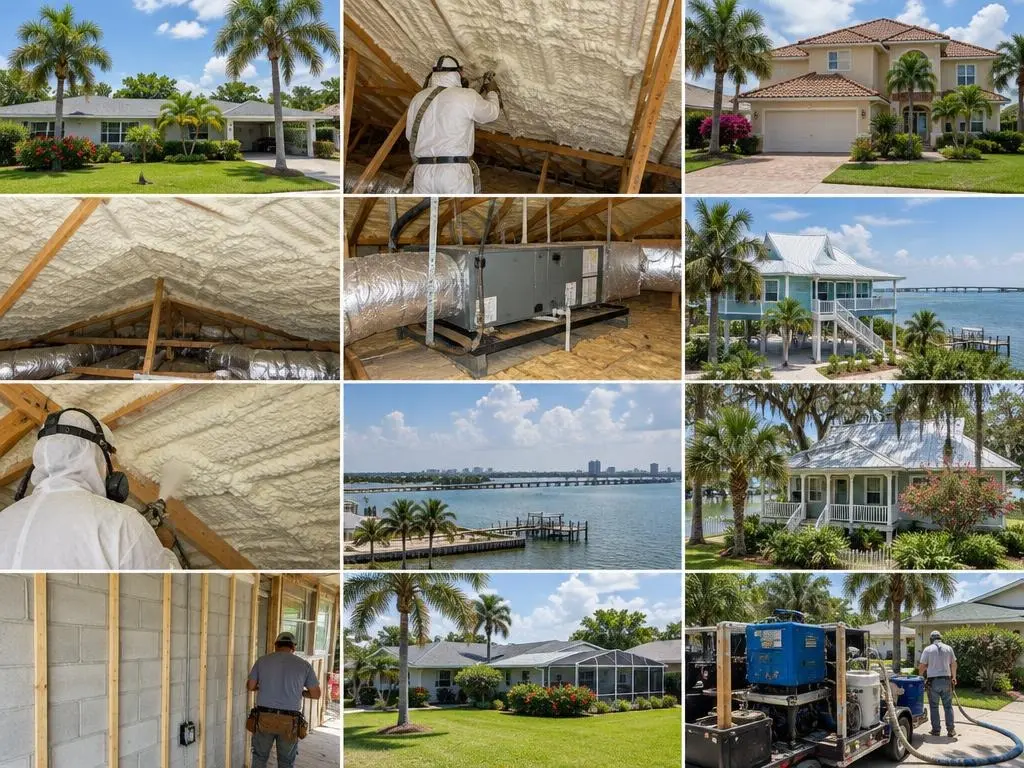
Spray Foam Cost Ranges From National Guides
| Job | Range and source |
|---|---|
| Spray foam, installed | $1.50 to $5.00 per sq ft (HomeGuide) |
| Open-cell / closed-cell | $1.50 to $3.50 / $3.00 to $5.00 per sq ft (HomeGuide) |
| Roughly 1,000 sq ft | $1,500 to $5,000 (HomeGuide); $3,150 to $7,500 in an existing home (Fixr) |
| Existing walls / new construction | $3.15 to $7.50 / $2.75 to $6.50 per sq ft (Fixr) |
| Every exterior wall | $4,000 to $10,000 (HomeGuide) |
| Entire house | $8,000 to $20,000 (HomeGuide); $10,000 to $30,000 (Fixr) |
| Usual minimum charge | $1,000 to $2,000+ (HomeGuide) |
National ranges from HomeGuide's 2026 guide and Fixr's 2025 guide, not local quotes. Foam type, thickness, access and prep work move the total, and small jobs often hit a minimum. We measure your house and the number on our written estimate is what you pay.
How a Foam Job Runs
1. Look and measure
We inspect each space, check the roof, ducts and wiring, and measure the surfaces.
2. Written quote
Each area gets a foam type, thickness, target R-value and price.
3. Prep
We cover and mask, set up ventilation and close off the work area.
4. Spray and trim
Foam goes on in passes to the planned thickness, then excess is trimmed where needed.
5. Cleanup and walk-through
We clean up, show you the work and tell you when the space is ready to use.
Why Choose Us for Spray Foam Insulation
Foam only where it pays
If air sealing and blown-in reach the target for less in part of the house, we tell you.
Thickness on paper
Thickness and R-value are listed area by area, so you can compare bids fairly.
Roof checked first
We look for leaks and damaged sheathing before foam covers the deck.
Spray Foam Insulation Questions
Is open cell or closed cell better for a Florida attic?
Under a typical pitched roof, open-cell is common because there is room for the depth and it costs less per square foot. Closed-cell makes sense on low-slope roofs, shallow rafters and areas where moisture is a concern. Some jobs use both.
Who manufactures spray foam insulation?
Several chemical companies make spray polyurethane foam systems sold to installers, and hardware stores carry small kits and cans for gaps. What matters more for you is the type of foam, the thickness installed and how the job is set up. Our quote names the foam type and thickness for each area.
Does spray foam stop humidity from getting into the house?
It stops air leaks, and humid outdoor air comes in mostly through leaks. Closed-cell foam also slows vapor moving through the surface. Your air conditioner still controls indoor humidity, but a tighter house gives it less damp air to deal with.
Will spray foam make my roof hotter?
Shingles under a foamed roof deck can run somewhat warmer because the attic no longer cools the deck from below. Shingle makers have their own policies on this, so ask your roofer or check your roof's warranty terms before deciding.
Spray Foam Insulation Service Areas
- Spray Foam Insulation in Clearwater, FL
- Spray Foam Insulation in Largo, FL
- Spray Foam Insulation in Dunedin, FL
- Spray Foam Insulation in Palm Harbor, FL
- Spray Foam Insulation in Safety Harbor, FL
- Spray Foam Insulation in Oldsmar, FL
- Spray Foam Insulation in Tarpon Springs, FL
- Spray Foam Insulation in Seminole, FL
- Spray Foam Insulation in Pinellas Park, FL
- Spray Foam Insulation in East Lake, FL
- Spray Foam Insulation in Belleair, FL
- Spray Foam Insulation in Belleair Bluffs, FL
- Spray Foam Insulation in Indian Rocks Beach, FL
- Spray Foam Insulation in Holiday, FL
- Spray Foam Insulation in New Port Richey, FL
- Spray Foam Insulation in Trinity, FL
- Spray Foam Insulation in Westchase, FL
- Spray Foam Insulation in Town 'n' Country, FL
- Spray Foam Insulation in Kenneth City, FL
- Spray Foam Insulation in Madeira Beach, FL
Get a Spray Foam Insulation Estimate
We will look at the spaces and tell you where foam earns its cost.