
Pinellas County seat on Clearwater Harbor
Spray Foam Insulation in Clearwater, FL
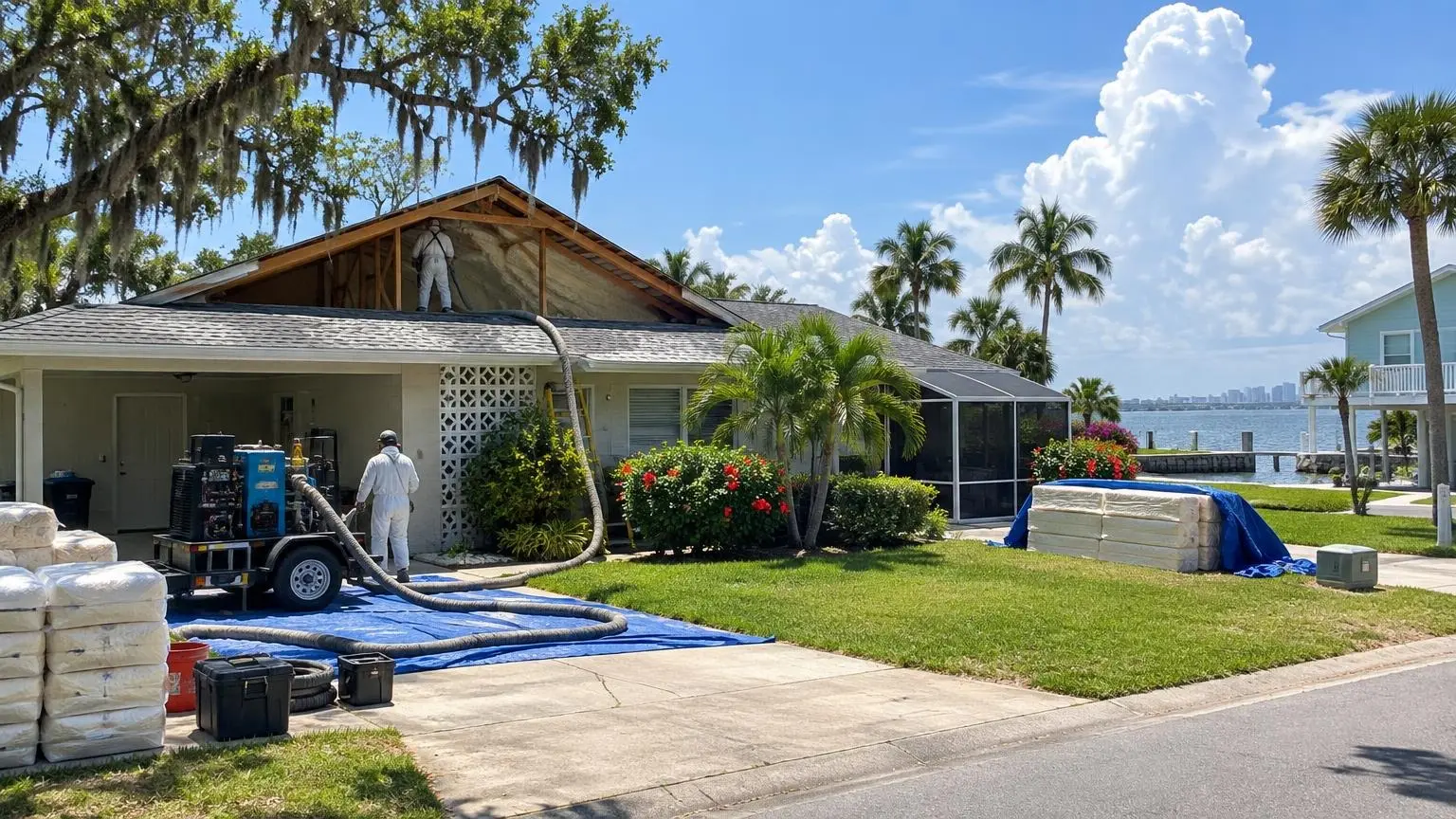
From Harbor Oaks bungalows to 1970s block ranches, we keep the summer heat in the attic where it belongs.
- Free on-site estimates
- Written quote naming foam type, thickness and R-value for each area
- Attic, ducts and roof leaks checked before anything is covered
A City That Grew Up Fast After the War
Spray Foam Insulation in Clearwater mostly means fighting heat that pours down from the attic for about half the year. The city's climate table on Wikipedia lists average highs of 89.9F in July and 90.0F in August, with summer nights holding near 74F and roughly 104 days of measurable rain a year. Houses here were built for that heat in different eras, and the attic is where most of them lose the battle.
Three building booms in one city
Clearwater was settled in 1888 as Clear Water Harbor, incorporated as a town in 1891 and reincorporated as a city in 1915. Its population then jumped from 15,581 in 1950 to 34,653 in 1960 and 52,074 in 1970. That growth filled the city with block ranch houses on slabs, many with low-pitched roofs and shallow attics. Later decades added the subdivisions and condos of the Countryside area in the north end, and Clearwater Beach on its own barrier island, linked to the mainland by bridge since the 1910s.
What we find in Clearwater attics
In the postwar ranches, the attic often holds a few inches of old batts or loose fill, plus ductwork and sometimes the air handler. The 2023 Florida Building Code, Energy Conservation calls for R-38 in ceilings in climate zone 2 for new work, and many of these attics sit well below it. In two-story homes from the 1980s and 1990s, the trouble spot is often the bonus room or the second floor under a vaulted ceiling, where there is little room for insulation and the air conditioner struggles every afternoon.
Choosing the approach
If the air handler and ducts are in the attic, foam on the underside of the roof deck can bring them inside the insulated shell. If not, sealing the ceiling and blowing in loose fill to depth usually costs less. On the beach side, where houses and condos face salt air and storm water, we check for leaks and damaged insulation first. Hurricane Helene's surge in 2024 was followed by fires in multiple buildings on Clearwater Beach, and wet insulation from that storm still turns up in attics and walls.
Owners and long-term residents
Census QuickFacts shows that 58.6% of Clearwater homes are owner-occupied and 24.1% of residents are 65 or older, with a median owner-occupied home value of $361,300 for 2020-2024. Many owners plan to stay put, which is when insulation upgrades pay back best.
Harbor Oaks and the older core
The U.S. Army built Fort Harrison here around 1835 as a Seminole Wars outpost, and the site later became part of the Harbor Oaks residential area south of downtown. Homes in the older core near the bluff are some of the oldest in the city, often frame houses with raised floors, plaster walls and attics reworked many times. We check wiring and framing before suggesting foam, and dense-pack or blown-in often fits those houses better.
Tell us what part of the house feels the heat, and we will look and send a written quote. Get a free estimate
What to Know in Clearwater
- Summer heat and rain. Clearwater's climate table lists July and August highs of 89.9F and 90.0F, summer lows near 74.2F and 52.6 inches of rain a year over about 104 rainy days (Wikipedia).
- Postwar growth. Clearwater grew from 15,581 people in 1950 to 52,074 in 1970, the era when much of its block-and-slab housing went up (Wikipedia census table).
- Ownership and age. Census QuickFacts lists a 58.6% owner-occupancy rate, a median owner-occupied value of $361,300 (2020-2024) and 24.1% of residents age 65 or older.
- Ceiling code target. The 2023 Florida Building Code, Energy Conservation, effective December 31, 2023, lists R-38 for ceilings in climate zone 2, which includes Pinellas County.
Clearwater Questions
My Clearwater house is a 1960s block ranch. Where should I start?
Start in the attic. Most homes from that era have a low roof, thin attic insulation and ducts overhead. Sealing the ceiling and either topping up the floor or foaming the roof deck usually does more than any wall work.
Do beach-side homes need a different approach?
The insulation goals are the same, but salt air, storm water and raised construction change the details. We look for past water damage first and check whether floors over open space need insulation.
Can you work in Countryside condos and townhomes?
Yes, where the owner controls the attic or ceiling space. Shared attics and roofs usually need the association's approval, so check your documents first.
Do Clearwater homes need a permit for insulation work?
Requirements depend on the scope of the job and the city's current rules. Simple attic top-ups are handled differently from work that changes roof venting or is part of a remodel. Check with the City of Clearwater's building office, and we will describe the scope in writing for you.
Free Estimates in Clearwater, FL
Free on-site estimates anywhere in Clearwater, from Countryside to the beach.
Spray Foam Insulation Near Clearwater
- Spray Foam Insulation in Largo, FL
- Spray Foam Insulation in Dunedin, FL
- Spray Foam Insulation in Palm Harbor, FL
- Spray Foam Insulation in Safety Harbor, FL
- Spray Foam Insulation in Oldsmar, FL
- Spray Foam Insulation in Tarpon Springs, FL
- Spray Foam Insulation in Seminole, FL
- Spray Foam Insulation in Pinellas Park, FL
- Spray Foam Insulation in East Lake, FL
- Spray Foam Insulation in Belleair, FL
- Spray Foam Insulation in Belleair Bluffs, FL
- Spray Foam Insulation in Indian Rocks Beach, FL
- Spray Foam Insulation in Holiday, FL
- Spray Foam Insulation in New Port Richey, FL
- Spray Foam Insulation in Trinity, FL
- Spray Foam Insulation in Westchase, FL
- Spray Foam Insulation in Town 'n' Country, FL
- Spray Foam Insulation in Kenneth City, FL
- Spray Foam Insulation in Madeira Beach, FL