
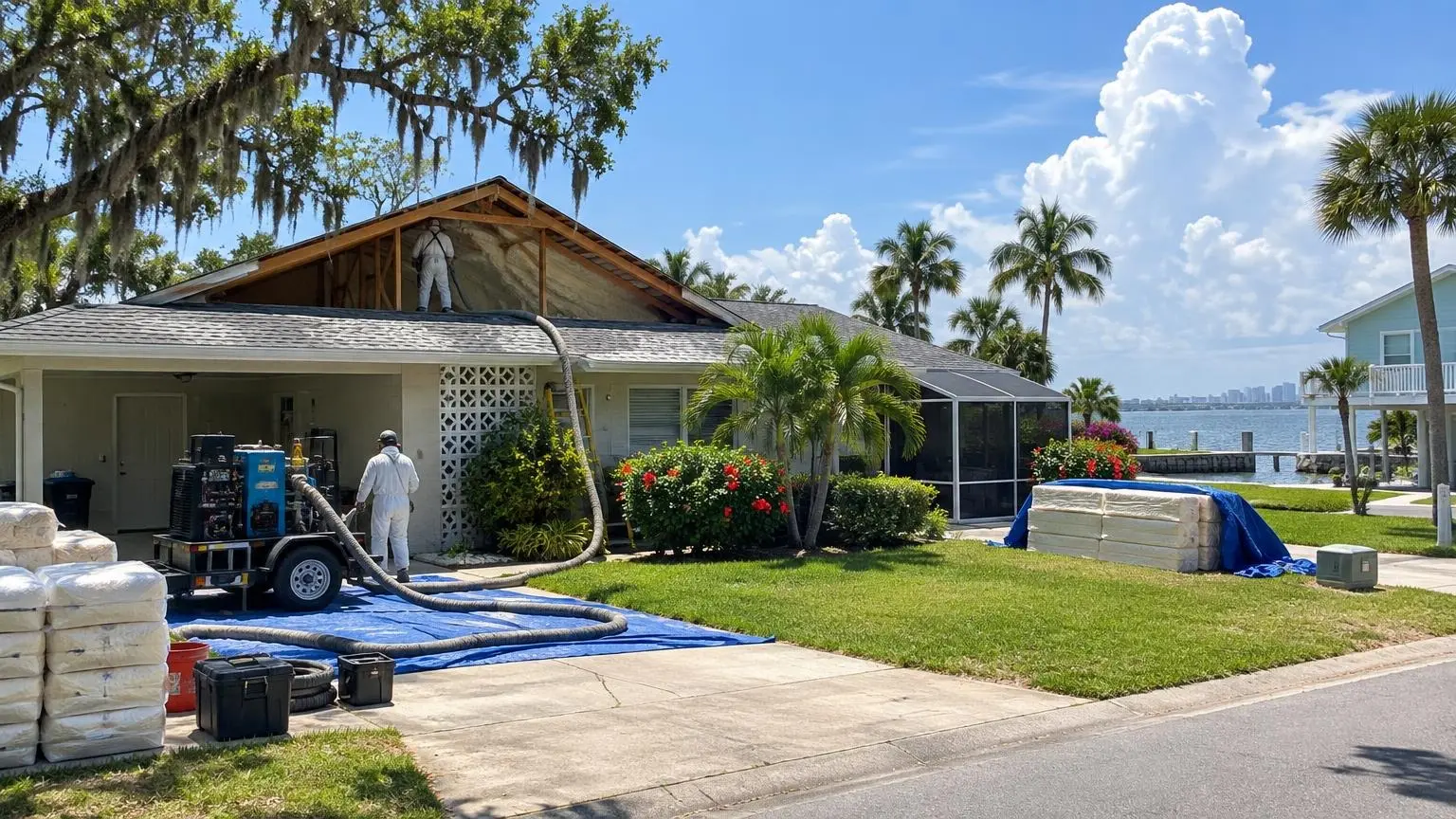
Attics, roof decks and walls across North Pinellas
Spray Foam Insulation in Clearwater, FL
Keep the Gulf Coast heat and humidity in the attic, not in your living room, with foam and air sealing priced area by area in writing.
- Free on-site estimates
- Written quote naming foam type, thickness and R-value for each area
- Attic, ducts and roof leaks checked before anything is covered
Insulation for a House That Fights Heat, Not Cold
Spray foam insulation in Clearwater has one main job: keep a hot, humid attic from pushing heat and moisture into the house. Wikipedia's climate table for Clearwater lists average highs near 90F in both July and August and nights that stay around 74F, with about 52.6 inches of rain a year. We are spray foam insulation contractors who work through that climate every day, sealing and insulating attics, roof decks and walls with open-cell or closed-cell foam where it earns its cost, and with blown-in insulation where that does the job for less.
Heat and humidity, in numbers
The Tampa International Airport climate record for 1991-2020 shows an average relative humidity of 74.1% over the year and an August dew point of 73.0F. That matters for insulation in two ways. First, a typical attic under a dark shingle roof gets far hotter than the outdoor air, so ceiling insulation is your main defense against the afternoon sun. Second, every gap in the ceiling or walls lets in air that carries moisture your air conditioner then has to remove. In a home like that, air sealing pays off as much as R-value does.
What the code asks for
The 2023 Florida Building Code, Energy Conservation (8th edition) took effect on December 31, 2023. Pinellas, Pasco and Hillsborough counties are classed as climate zone 2A (hot-humid), and the prescriptive table for zone 2 calls for R-38 in ceilings, R-13 in wood-frame walls and R-6 on the interior of block walls (or R-4 continuous). For existing homes, the U.S. Department of Energy suggests R-49 to R-60 for an uninsulated zone 2 attic, or adding R-38 to R-49 where 3 to 4 inches already sit on the attic floor. Plenty of older North Pinellas attics are well short of that.
Closed cell vs open cell in a Florida house
Open-cell foam is soft and light, rated about R-3.5 to R-3.7 per inch by HomeGuide. It expands a great deal, seals air well and costs less per square foot, which makes it a common choice under roof decks and in interior walls. Closed-cell foam is dense and rigid, about R-5 to R-7 per inch, and holds back both water vapor and liquid water at normal thickness. Here we use it where a surface may get wet or where space is tight: block walls, the underside of low-slope roofs, garage ceilings and small cavities. We name the foam for each area on the quote and explain why.
Roof deck or attic floor?
This is the biggest decision on most Clearwater jobs. In many Pinellas houses the air handler and ductwork sit in the attic. If the insulation stays on the attic floor, that equipment lives in a space that can reach well above outdoor temperature on a summer afternoon. Spraying foam against the underside of the roof deck brings the attic inside the insulated shell, so the ducts sit in a much milder space. It costs more than topping up the floor, and it must be done to the Florida Building Code rules for unvented attics. When the ducts are elsewhere, or the budget is tight, sealing the ceiling and adding blown-in insulation is usually the better value. We price both when both make sense.
What spray foam insulation costs
National cost guides give a starting point. HomeGuide puts installed spray foam at $1.50 to $5.00 per square foot, with open-cell at $1.50 to $3.50 and closed-cell at $3.00 to $5.00, and foam under a roof deck at $1,500 to $9,000. Fixr lists $2,500 to $12,000 for foaming the attic of an existing home. The size of the roof, foam type and thickness, attic access and whether old insulation comes out first move the number. Your written estimate, after we have seen the house, is the price.
Hiring spray foam insulation companies
Whether you are comparing insulation contractors in Clearwater or searching for spray foam insulation near me, ask every company the same things. Which foam, how thick, and what R-value in each area? Will they seal the attic floor or the roof deck, and what happens to the existing insulation? How do they handle the ventilation and fresh air for the space? What should you do while it cures (HomeGuide advises leaving for 24 hours or more)? A good quote answers all of that in writing, and that is how ours are written.
Storms, water and old insulation
Pinellas had not taken a direct hurricane hit since 1921, according to Wikipedia, but Hurricane Helene's surge in September 2024 affected more than 29,000 homes and businesses in the county. Wet insulation does not dry well and holds odors and mold, so after a leak or a flood we remove it, let the framing dry and replace it. If a roof leak caused the problem, it has to be fixed before we insulate.
Tell us what you are noticing, whether it is a hot bedroom, a sweating duct or a power bill that climbs every June, and we will come out, look and give you a written price. Get a free estimate
What We Insulate
Six kinds of work, from spraying foam under a roof deck to blowing loose fill across an attic floor or pulling out storm-soaked batts.
Spray Foam Insulation
Open-cell and closed-cell foam that insulates and air seals in one layer, matched to each surface in a hot-humid house.
Learn more →Attic Insulation & Air Sealing
Seal the ceiling, then bring the attic floor up to a zone 2 target, the lowest-cost way to cool a hot upstairs.
Learn more →Roof Deck Spray Foam
Foam on the underside of the roof so the attic, ducts and air handler sit inside the cooled part of the house.
Learn more →Wall Insulation
Block walls and frame walls insulated during remodels and additions, or dense-packed from outside in older frame homes.
Learn more →Blown-In Insulation
Loose-fill fiberglass or cellulose blown across the attic floor to depth, the lowest-cost route to a high attic R-value.
Learn more →Insulation Removal & Replacement
Wet, moldy, rodent-soiled or flattened insulation vacuumed out, the attic cleaned and sealed, and new insulation put back.
Learn more →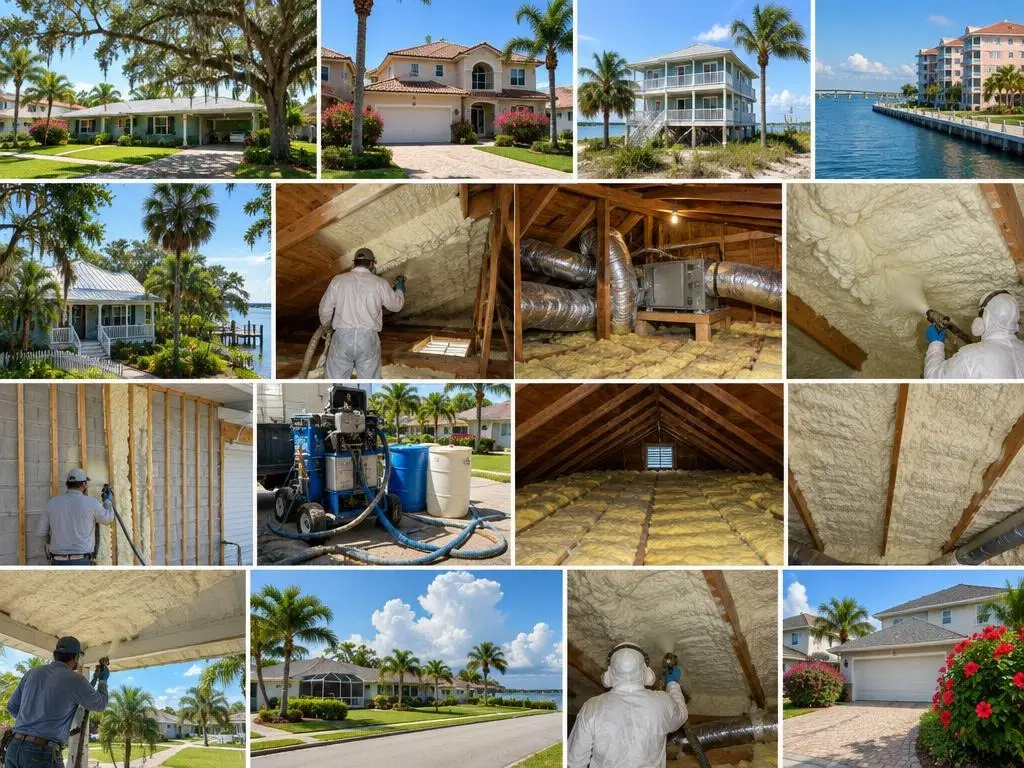
Where We Work Around Clearwater
We work in Clearwater and across North and mid Pinellas: Dunedin, Palm Harbor, East Lake, Tarpon Springs, Safety Harbor, Oldsmar, Largo, Belleair, Belleair Bluffs, Seminole, Pinellas Park and Kenneth City, plus the beach towns of Indian Rocks Beach and Madeira Beach. North of the county line we cover Holiday, New Port Richey and Trinity in Pasco, and east across the bay we work in Westchase and Town 'n' Country. The mix of houses changes a lot from town to town: older bungalows and block ranches near the bay, 1980s and 1990s subdivisions around Palm Harbor and East Lake, raised homes and seasonal condos on the barrier islands, and newer deed-restricted neighborhoods in Westchase and Trinity. Each town page covers what is different there.
- Spray Foam Insulation in Clearwater, FL
- Spray Foam Insulation in Largo, FL
- Spray Foam Insulation in Dunedin, FL
- Spray Foam Insulation in Palm Harbor, FL
- Spray Foam Insulation in Safety Harbor, FL
- Spray Foam Insulation in Oldsmar, FL
- Spray Foam Insulation in Tarpon Springs, FL
- Spray Foam Insulation in Seminole, FL
- Spray Foam Insulation in Pinellas Park, FL
- Spray Foam Insulation in East Lake, FL
- Spray Foam Insulation in Belleair, FL
- Spray Foam Insulation in Belleair Bluffs, FL
- Spray Foam Insulation in Indian Rocks Beach, FL
- Spray Foam Insulation in Holiday, FL
- Spray Foam Insulation in New Port Richey, FL
- Spray Foam Insulation in Trinity, FL
- Spray Foam Insulation in Westchase, FL
- Spray Foam Insulation in Town 'n' Country, FL
- Spray Foam Insulation in Kenneth City, FL
- Spray Foam Insulation in Madeira Beach, FL
Why Homeowners Call Clearwater Spray Foam Insulation
We see the attic before we price it
Every quote follows a visit to the attic and any other space in the job, so the number reflects your house, not a guess over the phone.
Roof deck and attic floor both on the table
Where your ducts sit decides a lot. If two approaches would work, the quote prices both side by side.
Air sealing comes first
Can lights, bath fans, top plates and the attic hatch are sealed before any new insulation goes over them.
Specifics you can compare
Each area on the quote lists the material, thickness or depth, target R-value and price, so it lines up against any other bid.
Common Questions
What type of insulation is best for a house in Florida?
It depends on the part of the house. On an open attic floor, sealing the ceiling and adding blown-in fiberglass or cellulose to around R-38 or more is often the most economical choice. Where ducts sit in the attic, open-cell or closed-cell foam under the roof deck can bring them inside the insulated shell. Block walls are usually insulated from the inside with foam or rigid board during a remodel.
What is the cost of closed-cell spray foam insulation per square foot?
HomeGuide lists closed-cell spray foam at $3.00 to $5.00 per square foot installed, compared with $1.50 to $3.50 for open-cell. The thickness you need, access and prep change the total. Our written estimate after the visit is what you pay.
Does spray foam insulation waterproof?
No. Closed-cell foam absorbs very little water and slows vapor, which helps on block walls and low-slope roofs, but it is not a roof or a waterproofing system. Open-cell foam lets water pass through. Roof and plumbing leaks need to be fixed at the source before any foam goes in, or the foam can hide wet wood.
Will spray foam under my roof deck trap moisture?
It can if the job is designed badly, which is why Florida's residential code has a section on unvented attics. The roof has to be sound, the foam must be the right type and thickness, and the attic is treated as part of the conditioned house rather than sealed off with no air exchange. We check the roof and explain how the attic will be handled before you decide.
How much attic insulation does Florida code require?
For new work, the 2023 Florida Building Code, Energy Conservation lists R-38 for ceilings in climate zone 2, which includes Pinellas. The Department of Energy suggests R-49 to R-60 for an uninsulated attic in zone 2 and adding R-38 to R-49 where a few inches already exist. Your building department applies the code to permitted work.
Can I get a Duke Energy rebate for attic insulation?
Duke Energy Florida lists attic insulation in its Home Energy Improvement program. Its posted rules require a free Home Energy Check first, an existing attic averaging R-19 or less, and a Duke Energy-approved contractor. Check the current rules and the approved contractor list with Duke before the work starts.
Is DIY spray foam from a hardware store worth it?
Canned foam and small kits are fine for sealing gaps around pipes and wires. Spraying a whole attic or roof deck is different: thickness, temperature, mixing and ventilation all affect how the foam cures. For anything larger than a few small gaps, a professional installation is the safer choice.
How long do we need to stay out of the house?
HomeGuide advises vacating for 24 hours or more while spray foam cures. Blown-in insulation and air sealing work usually do not require you to leave. We tell you the plan for your job before the work day.
Get a Spray Foam Insulation Estimate
We look at the attic and any other spaces, then send a written price with the material and R-value for each area.